Communications • Strategic Partnerships • Project Leadership
Communicating with Clarity and Purpose
Helping organizations turn complex ideas into clear messages that build trust, engagement, and action.
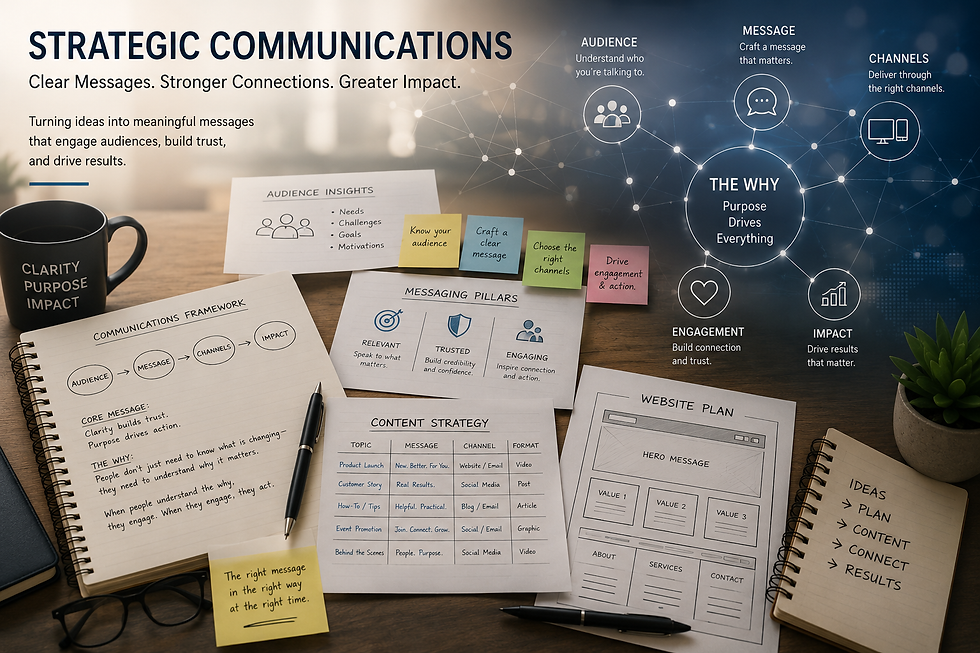

My Perspective
Throughout my career, I've seen how communication can influence whether an idea succeeds or struggles to gain traction. Whether supporting automotive product launches, developing training programs, producing events, creating marketing materials, or helping organizations tell their story, one principle has remained consistent: people need clarity before they can take action.
Too often, organizations focus on what they want to communicate before considering what their audience needs to understand. Effective communication is not simply about sharing information. It is about creating understanding, building trust, and helping people see why something matters.
One lesson that has stayed with me came from a large automotive training initiative. Before discussing features, processes, or expectations, we spent significant time focused on what we called “The Why.” The goal was simple: help participants understand the purpose behind the initiative before asking them to embrace change. When people understand the why, engagement and adoption become much easier.
Today, I continue to apply that same philosophy. Whether developing content, building websites, planning campaigns, producing training materials, or helping organizations clarify their message, my focus is helping people communicate with greater purpose, clarity, and impact.
What I've Learned
Over the years, I've noticed that communication challenges rarely stem from a lack of information. More often, they occur because messages are unclear, audiences are misunderstood, or important details become lost between intention and execution.
I've learned that effective communication begins with understanding the audience, defining the message, and communicating with consistency. The strongest organizations are often not the loudest. They are the ones that communicate clearly, align their teams, and help people understand both what is happening and why it matters. Whether supporting a business launch, introducing a new initiative, promoting an event, or developing training materials, successful communication creates clarity, builds trust, and motivates action.
The Opportunity
In many organizations, communication challenges rarely begin with bad intentions. Leaders are often passionate about their mission, teams are working hard, and important initiatives are moving forward. The challenge is that people frequently assume everyone shares the same understanding of goals, priorities, and expectations. I've encountered situations where teams were receiving information, but not necessarily clarity. Messages were being delivered, yet different audiences interpreted them in different ways. This often resulted in confusion, inconsistent execution, missed opportunities, and unnecessary frustration.
The opportunity was not simply to communicate more. It was to communicate more effectively—creating alignment, simplifying complex information, and helping people understand both what was happening and why it mattered.
Creating Clarity
Effective communication often begins long before a presentation, marketing campaign, or training session. In many situations, my approach has been to first understand the people involved—their concerns, motivations, goals, and perspectives. Before introducing a new idea, process, or initiative, I have often found it more valuable to listen first, ask questions, and identify potential barriers to acceptance.
One example came while supporting dealership software implementation programs. Before introducing new processes or training, I spent time building rapport, learning concerns, and understanding the personalities of the people involved. Establishing trust first made it much easier to gain acceptance and create meaningful engagement when it was time to introduce change. Creating clarity often begins with listening.
The Outcome
When communication improves, people become more engaged, collaboration becomes easier, and ideas gain momentum. I've often found that clarity helps reduce uncertainty, strengthen relationships, and create a greater sense of shared purpose. Whether working with business owners, project teams, event planners, community partners, or training participants, the most productive outcomes have usually occurred when people felt heard, respected, and included in the process. Clear communication helps people move beyond assumptions, discover common ground, and work together more effectively toward a shared goal.
When trust and understanding are established, something powerful begins to happen. Individual perspectives start to align, collaboration becomes more natural, and genuine synergy can emerge. At that point, communication is no longer simply about exchanging information, it becomes a catalyst for progress, innovation, and meaningful results.
Key Takeaways
Effective communication is about more than delivering information. It is about creating understanding, building trust, and helping people move toward a common goal. Whether working with a business owner, project team, community partner, or training participant, the most productive conversations often begin with listening.
✓ Listen first, then communicate.
✓ Build trust before seeking buy-in.
✓ Help people understand not only what is happening, but why it matters.
✓ Focus on common ground and shared goals.
✓ Clear communication creates alignment, momentum, and better outcomes.

Trusted By Those I've Worked With
Feedback from clients, colleagues, partners, and project collaborators.
"John proved his ability to seamlessly adapt to rapidly changing conditions while never losing his grasp of the overall project direction."
Craig Morningstar
Automotive Training & Sales Manager
"His thoughtful ideas and innovative approach helped improve the effectiveness of our training programs."
Dr. Marilynn Bell,
Director of Training & Development
"John brings clarity, insight, and enthusiasm while demonstrating a remarkable ability to understand complex ideas and opportunities."
Dr. Kenneth B. Woodside
Leadership Consultant
& Executive Coach
"His most impressive qualities are his highly developed written and oral communication skills. John is exceptionally articulate and works well with people from diverse backgrounds and age groups."
Cathy E. Howard
Program Counselor, Higher Education Opportunity Committee (HEOC), Wayne State University
“John was amazing. He was
always professional, kept
deadlines and is very personable.
He went above and beyond when
I worked with him. He was very
flexible and had a lot of creative
ideas.”
Shannon Garofalo,
Internet Director, Toyota of
Naperville
"John brings people together and inspires others to see what's possible. His production of our Get-Out-The-Vote Rally was top-notch and exceptionally well coordinated."
A.J. O'Neal
Founder, Detroit Bold Coffee | Former Owner, AJ's Music Café